
Introducing CFD with Examples by Dr. Mrinmoy Majumder – A Practical Guide to Computational Fluid Dynamics
“CFD with Examples” is a well-structured, pedagogically thoughtful introduction to computational fluid dynamics that effectively bridges theory, numerics, and practical application

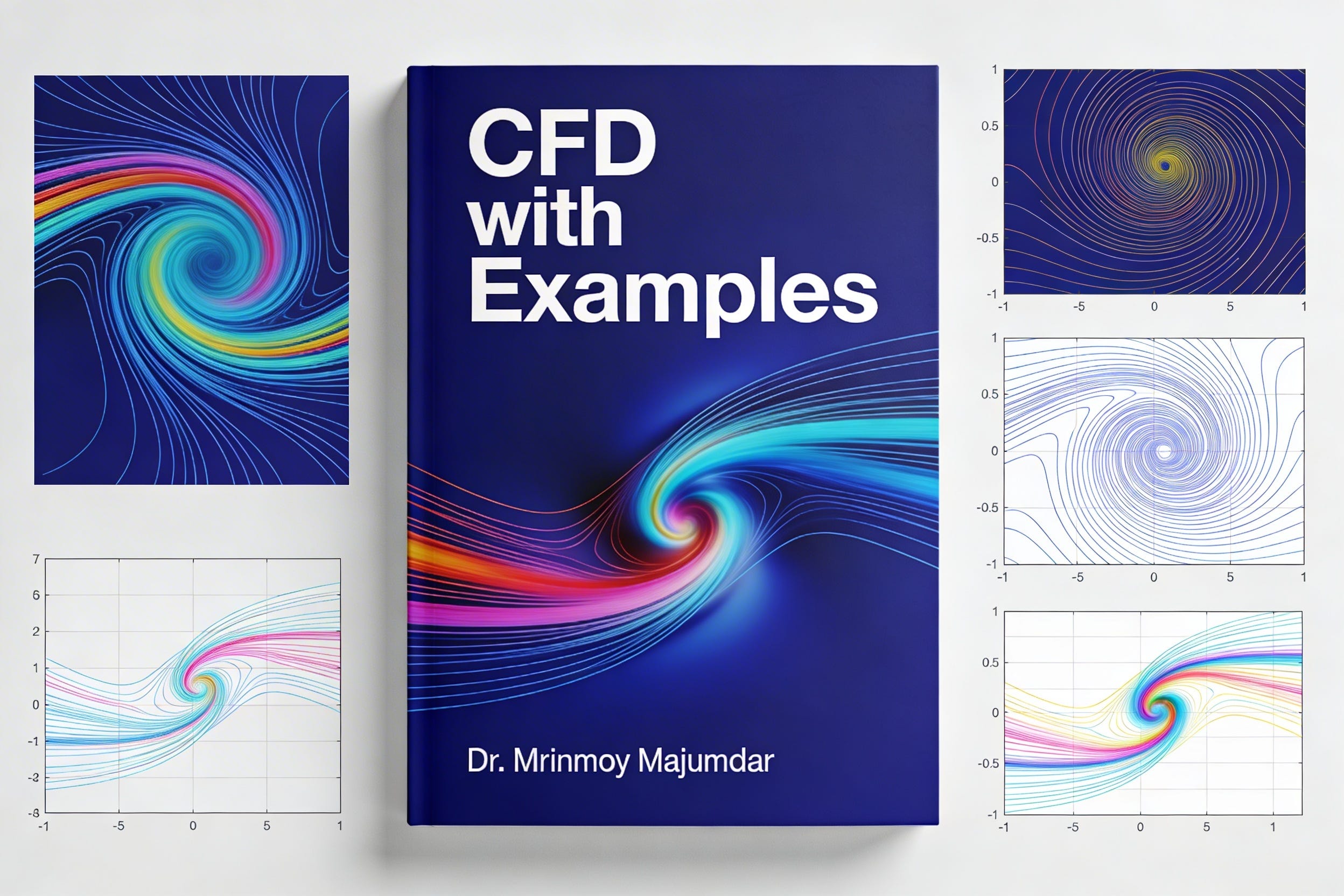
Overall impression
The book presents CFD as an integrated learning journey, combining concise written explanations, logically ordered modules, and QR-linked video tutorials into a coherent hybrid resource. This design makes the material accessible to students and early-career researchers who may find traditional CFD texts too abstract or algebra-heavy.
Structure and pedagogy
The progression from PDE classification and Taylor series to convergence, discretization schemes, and full FDM treatment is logically layered and cumulative.
Each module begins with a short “why this matters” introduction, which clearly frames the relevance of the topic before diving into formulas or algorithms.
The inclusion of a substantial preface, an introduction that defines CFD and its motivations, and explicit guidance on prerequisites and how to use the tutorial greatly helps self-learners pace themselves.
Content depth and coverage
Early modules (1–3) give a solid mathematical foundation on PDE types, Taylor series, and stability–convergence concepts, with explicit mention of CFL, von Neumann analysis, and the Lax Equivalence Theorem, which is often under-emphasized in introductory material.
Mid-level modules on elliptic and parabolic PDEs (4–7) cover both direct and iterative approaches, including Gauss–Seidel and SOR/Lieberman methods, with attention to convergence and computational cost.
Advanced numerical ideas such as Crank–Nicholson and Richardson extrapolation are motivated not just algorithmically but through their role in accuracy, stability, and grid-convergence studies.
The FDM module and the concluding case study on CFD–MCDM for flood forecasting successfully connect “textbook” numerics to realistic water-resources applications, which is a distinctive strength.
Hybrid format and usability
The one-QR-code-per-module layout with clear captions and direct URLs turns the PDF into a blended learning workbook rather than a static handout.
The solved numericals in Module 12, separated into Crank–Nicholson and FDM parts, provide worked examples that reinforce earlier theory and give readers a template for their own problem solving.
The explicit study roadmap (read intro → watch video → work examples → revisit concepts → practice numericals) offers practical learning scaffolding that many technical books omit.
Audience and impact
The assumed background (calculus, basic differential equations, linear algebra, some programming) is realistic for senior undergraduates, postgraduates in engineering, and practitioners transitioning into CFD.
By anchoring a major case study in flood forecasting with MCDM, the book is particularly valuable for learners in water resources, environmental engineering, and hydroinformatics, where CFD is often used but rarely taught from first principles.
Overall, “CFD with Examples” stands out as a learner-friendly CFD primer that thoughtfully combines rigorous numerical foundations with practice-oriented videos and case studies, making it a strong recommendation for engineers and researchers beginning their CFD journey
Here is the content of the book
Module 1: Classification of Linear PDF
Module 2: Taylor Series Expansion
Module 3: Condition of Convergence and Stability in Discretisation
Module 4: Discretisation of Elliptic PDE by Direct Method
Module 5: Discretisation of Elliptic PDE by Gauss-Seidel Method
Module 6: Discretisation of Elliptic PDE by Lieberman Method
Module 7: Discretisation of Parabolic PDE
Module 8: Crank Nicholson Method
Module 9: Richardson Extrapolation Method
Module 10: Finite Difference Method
Module 11: Case Study 1: Application of Computational Fluid Dynamics and Multi-Criteria Decision in Flood Forecasting
Module 12: Solved Numericals
Many more to come
Please note: This is a video book. You have to scan the QR to access the lectures.
Help us reach 1,500 subscribers this month, and we’ll gift Lecture Notes on MCDM as a FREE download to every subscriber who refers at least one new reader.
If you’re enjoying the articles in this newsletter, we’d be grateful for your support. You can contribute by making a donation(alternate link), submitting your own articles, joining us as a paid member(click here to pay in INR), or sponsoring us(Contact us for more details. Email at contact@baipatra.ws). Your support, in any form, is vital to helping us sustain and grow. Thank you!
You may also like :
1)International Journal of HydroClimatic Engineering: Call for Papers
2)Bio Inspired Optimization Technique Bundle Membership (alternate link)
3)How to open your own home page?(AD)
4)Podcast : Hydrology for Beginners
5)600 Interview Questions on Water Resources(alternate link)
7)Lecture Notes on MCDM(Alternative Link)
8)Learn GIS in One Page(Alternative Link)