

Now, for October 2026 only, I am giving away an annual HydroGeek membership for Rs.250 instead of Rs.600/=.Click here to become a paid member for only Rs.250/=(and save Rs.350/=). Click here to upgrade
We are offering a flat 25% discount on the Lecture Notes on MCDM — a video book that introduces 12 different MCDM techniques through simple, easy-to-understand examples.
This discount coupon is available for the first 10 users only. Once all 10 coupons have been used, the video book will be available at its original price.
Link to buy the video book: https://notionpress.com/in/read/lecture-notes-on-mcdm
Coupon Code : BEGIN2026
Water and power are deeply interconnected resources that underpin economic development, public health, food production, environmental sustainability, and human well-being. Water is required for hydropower generation, thermal-plant cooling, fuel production, and renewable-energy infrastructure, while energy is essential for extracting, pumping, treating, distributing, recycling, and desalinating water. Decisions made in one sector can therefore create direct benefits, constraints, or unintended consequences in the other. Managing water and energy as separate systems may overlook these interdependencies, whereas a nexus-based approach can identify synergies, reduce resource conflicts, and support more coordinated infrastructure planning.
The complexity of this relationship is increasing because of climate variability, urbanization, population growth, aging infrastructure, environmental degradation, and rising demands for reliable water and electricity services. Climate-related changes in rainfall, runoff, drought, floods, and sediment transport can influence reservoir storage and hydropower generation. At the same time, energy-intensive water supply, irrigation, treatment, and wastewater-management systems may face higher operating costs and greater exposure to power interruptions. These challenges demonstrate that sustainable resource management requires an integrated framework capable of considering water availability, energy demand, ecological requirements, infrastructure reliability, and socioeconomic priorities simultaneously. The United Nations consequently emphasizes integrated water and energy management as a means of realizing synergies and avoiding the adverse trade-offs associated with isolated sectoral planning.
Informatics provides the connecting layer through which this integration can be achieved. Advances in artificial intelligence, machine learning, the Internet of Things, remote sensing, geographic information systems, cloud computing, optimization, and real-time data analytics are changing how water and power systems are observed and managed. These technologies can support inflow and energy-demand forecasting, leakage and fault detection, pump scheduling, reservoir operation, predictive maintenance, flood warning, renewable-energy integration, and emergency decision-making. Instead of relying exclusively on historical operating rules and periodic observations, managers can increasingly use continuous sensor data and predictive models to evaluate emerging conditions and select appropriate responses.
Digital twins represent a particularly promising component of the water–power–informatics nexus. A digital twin combines a virtual representation of a physical system with real-time or near-real-time observations, simulation models, and decision-support functions. In the water sector, digital twins are being investigated for distribution networks, wastewater treatment, reservoirs, rivers, groundwater, stormwater infrastructure, and resource-recovery facilities. They can facilitate real-time monitoring, scenario simulation, predictive control, energy optimization, and proactive asset management. However, practical implementation remains constrained by inadequate data, interoperability problems, computational requirements, cybersecurity concerns, institutional fragmentation, and limited evidence of socioeconomic benefits.
The integration of artificial intelligence with digital twins creates further opportunities but also introduces questions about model reliability, uncertainty, transparency, and operational responsibility. For critical water and power infrastructure, a model with high predictive accuracy is not necessarily ready for autonomous deployment. Infrastructure-grade applications also require dependable sensor synchronization, explainable recommendations, human oversight, secure data exchange, fallback operating procedures, and periodic model revalidation. Current research indicates that the central challenge is moving beyond isolated simulations toward trustworthy systems that can function safely under changing environmental and operational conditions.americaspg
Against this background, the Water–Power–Informatics Nexus may be understood as a digital framework that integrates physical infrastructure, environmental processes, data systems, computational models, and decision-making mechanisms. Its purpose is not simply to digitize existing operations, but to enable coordinated and adaptive management across traditionally separated sectors. Such a framework can help reduce the energy intensity of water services, improve hydropower reliability, recover energy from water and wastewater networks, integrate floating solar and other renewables, anticipate infrastructure failures, and strengthen resilience to floods, droughts, power outages, and cyber-physical disruptions.
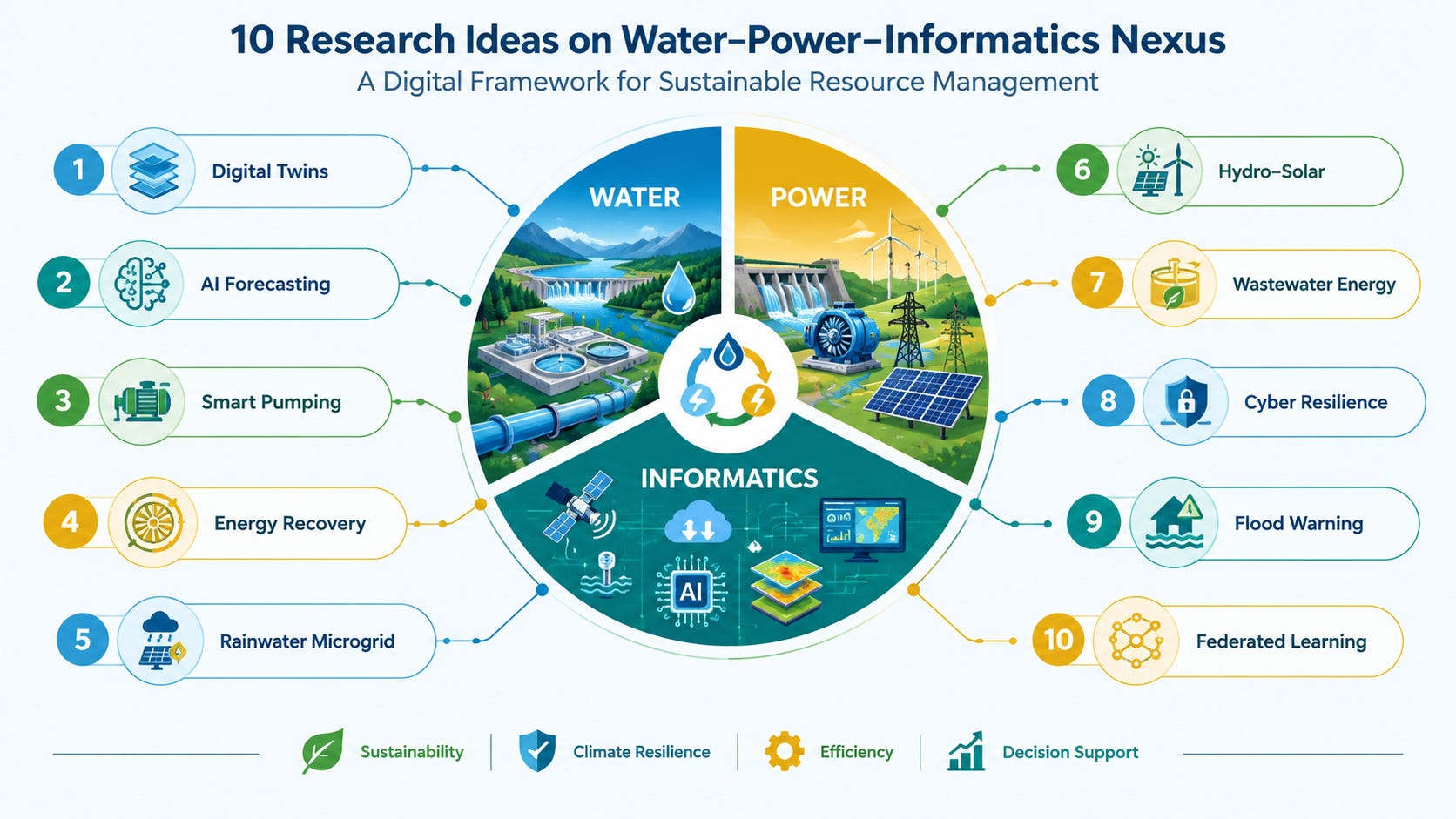
This article presents 10 research ideas on the Water–Power–Informatics Nexus, covering AI-enabled digital twins, explainable hydropower forecasting, energy-efficient pump scheduling, pressure-energy recovery, smart rainwater microgrids, floating solar–hydropower integration, energy-positive wastewater treatment, cyber-physical resilience, energy-aware flood warning, and privacy-preserving utility analytics. Together, these themes offer a multidisciplinary research agenda for developing water and power systems that are intelligent, resource-efficient, climate-resilient, and environmentally responsible. They also provide opportunities for converting conceptual models into field-scale applications, demonstrators, decision-support platforms, and implementable strategies for sustainable resource management.
Ten research ideas
Digital twin for climate-resilient hydropower reservoirs
Integrate real-time inflow forecasts, reservoir levels, power demand, environmental flows, and flood risk to optimize multipurpose reservoir operation. Digital monitoring, runoff forecasting, IoT, and optimization are increasingly important for climate-resilient hydropower.[mdpi][ieahydro]Explainable AI for inflow and hydropower forecasting
Compare LSTM, Transformer, physics-informed neural networks, and hybrid hydrological–machine-learning models. The study could generate probabilistic forecasts while explaining how rainfall, soil moisture, snowmelt, and antecedent flow affect predicted generation.Reinforcement learning for energy-efficient pump scheduling
Connect EPANET or WaterGEMS with demand forecasting and safe reinforcement learning to minimize energy costs while maintaining pressure and storage requirements. Pump scheduling, variable-speed operation, and pressure management offer substantial energy-saving opportunities.[iea.blob.core.windows][papers.ssrn]Pipeline fault detection with pressure-energy recovery
Develop a GIS–AI system that simultaneously identifies probable leakage or failure locations and suitable sites for pumps-as-turbines or microturbines. Entropy-TOPSIS or COPRAS could prioritize sites using fault probability, energy potential, economics, and water-quality risk.Smart rainwater water–energy microgrid
Optimize harvested rainwater allocation among drinking-water treatment, irrigation, storage, microhydropower, and pumped storage. This could extend your previous work on using rainwater for power generation, purified water, and agriculture.Hydropower–floating-solar reservoir optimization
Develop a GIS suitability and joint-dispatch model for floating solar and hydropower in Northeast India. Include reservoir area, seasonal water-level variation, evaporation, grid connectivity, fisheries, water quality, and environmental constraints.[documents1.worldbank]Digital twin for energy-positive wastewater treatment
Optimize aeration, pumping, anaerobic digestion, biogas production, nutrient recovery, and reclaimed-water use. Wastewater contains recoverable chemical, thermal, and hydraulic energy, creating opportunities for net-zero or net-positive treatment plants.[documents1.worldbank][energy]Cyber-physical resilience of interconnected water and power systems
Model cascading consequences of power outages, pump failures, communication losses, manipulated sensor readings, and cyberattacks. The output could be a resilience index and restoration strategy for critical pumps, reservoirs, substations, and communication links.[frontiersin][renewablewatch]Energy-aware flood warning and emergency resource allocation
Develop a platform that combines satellite rainfall, gauges, flood forecasts, outage prediction, and microgrid availability. Multi-objective optimization could allocate limited emergency power among telemetry stations, drainage pumps, hospitals, shelters, sirens, and communication systems—especially relevant to Northeast India.[epa][iea.blob.core.windows]Federated learning for water–energy utilities
Investigate whether multiple utilities can jointly train leak-detection, demand-forecasting, pump-fault, or energy-intensity models without sharing sensitive raw data. Evaluate privacy, transferability, concept drift, communication requirements, and differences among utility networks.[americaspg][indiawaterportal]
If you help me reach 2,000 subscribers by 21 December 2026, I’ll send a special bonus: a FREE copy of my book “600 Interview Questions on Water Resources” to everyone who refers at least one friend.
Learn in your Idle Time

If you’re enjoying the articles in this newsletter, we’d be grateful for your support. You can contribute by making a donation, submitting your own articles, joining us as a paid member, or sponsoring us(Contact us for more details. Email at contact@baipatra.ws). Your support, in any form, is vital to helping us sustain and grow. Thank you!
Subscribe to our YouTube channel and receive a free printable checklist titled “How I Observe a River.” After subscribing, just comment on this post to claim it.
Video Book Recommendations
Introduction to Flood Routing’
Flood routing is a crucial aspect of hydrology that involves the study of how water flows through river systems during periods of heavy rainfall or flooding. It plays a vital role in predicting and managing flood events, as well as understanding the potential impact on surrounding areas.This online tutorial will help you learn about the basics of Flood Routing,different methods of hydrologic and hydraulic routing,Clark IUH generation and Nash Hydrograph Generation etc. synthetic methods etc. All the methods are explained with examples. This book is suitable for Graduate and Post Graduate Engineers who are interested to get a basic knowledge regarding the flood routing methods.Please note This is a video book. You have to scan the QR Codes to access the tutorials.
Click here to download
Introduction to Multi-Criteria Decision-Making Making Techniques
This open-access short-term course provides a comprehensive introduction to Multi-Criteria Decision-Making (MCDM) methods applied to Water Resource Engineering and Environmental Management — from foundational theory to numerical practice and real-world project case studies.
Organized into 4 sections and 22 modules, the course covers:
🧩 MCDM Fundamentals — What is MCDM, working principles, WSM, WPM, and classification of techniques
⚖️ Pairwise Comparison Methods — Step-by-step tutorials on AHP (Analytical Hierarchy Process) and ANP (Analytical Networking Process)
📊 Outranking, Utility & Ranking Methods — ELECTRE I & II, PROMETHEE, MAUT, EVAMIX, TOPSIS, and applied water resource examples
📂 Case Studies — 8 real internship projects applying MCDM in coastal zone vulnerability analysis, wetland risk assessment, water resource management planning, and environmental impact studies
Click here to download
Call for Papers
International Journal of Hydroclimatic Engineering (IJHCE)
Submission deadline: None
The International Journal of Hydroclimatic Engineering (IJHCE) invites original research articles, review papers, and technical case studies in hydroclimatic engineering, hydrology, flood and drought management, water-resources systems, environmental modelling, climate impacts, GIS, remote sensing, and related interdisciplinary fields. Researchers and practitioners are encouraged to submit manuscripts that offer sound methods, meaningful results, and practical relevance. Submit your manuscript and contribute to resilient water and climate solutions.
Special Issue : Natural Hazards and Terrestrial Ecosystem Resilience for SDG 13 & SDG 15
Submission deadline: 03 September 2027
Achieving SDG 13 (Climate Action) and SDG 15 (Life on Land) requires an integrated response to the mutually reinforcing effects of climate change, natural hazards, ecosystem degradation, deforestation, land deterioration, and biodiversity loss. These goals emphasize strengthening climate resilience, integrating climate measures into planning, improving early-warning capacity, conserving terrestrial and freshwater ecosystems, restoring degraded land and forests, and protecting threatened species. To advance this agenda, All Earth invites interdisciplinary research that connects climate extremes and cascading hazards with ecosystem resilience through nature-based adaptation, integrated field observations, remote sensing, Earth-system modelling, artificial intelligence, resilience metrics, and compound-risk early-warning systems. The collection particularly encourages studies that translate scientific findings into practical approaches for ecosystem restoration, forest management, disaster-risk reduction, carbon mitigation, environmental equity, stakeholder participation, and evidence-based governance in vulnerable regions.
Special Issue : Multi-source Remote Sensing for Precision Agricultural Water Management: Mechanisms, Technologies and Field Applications
Submission deadline: 30 April 2027
Improving agricultural water management is vital for maintaining crop production, increasing water productivity, and reducing nutrient losses and pollution under growing water scarcity and climate variability. This Special Issue under the Agricultural Water Management Journal focuses on converting multi-source remote-sensing observations into practical precision-irrigation solutions by integrating satellite, UAV, ground-sensor, and model-based data. It welcomes research on retrieving crop water status, soil moisture, evapotranspiration, and related indicators; detecting crop water stress; assimilating remote-sensing data into crop and agrohydrological models; applying artificial intelligence and optimization to irrigation and fertigation; developing automated control and decision-support systems; and validating these technologies at field and regional scales. Collectively, the studies are expected to strengthen the link between remotely sensed information and actionable irrigation decisions, including when, where, and how much water and fertilizer should be applied.
Special Issue : AI for Water(AI4W): Artificial Intelligence for Water Science, Engineering, Governance, and Industry
Submission deadline: 31 August 2027
Engineering, a monthly international peer-reviewed journal of the Chinese Academy of Engineering, provides a platform for major advances in engineering science and technology. Its Special Issue, associated with the AI for Water Academic Alliance and the First International Conference on AI for Water, addresses growing water-system challenges caused by climate change, urbanization, aging infrastructure, ecological degradation, hydrological extremes, and increasing water-security demands. It invites research, reviews, perspectives, and commentaries on applications of machine learning, scientific and agentic AI, large language models, digital twins, remote sensing, sensor networks, and intelligent optimization in water forecasting, allocation, infrastructure management, ecological governance, and emergency response. Particular emphasis is placed on developing AI methods that are physically consistent, interpretable, trustworthy, operationally deployable, and capable of supporting scientific discovery, engineering innovation, and sustainable water management.
Latest Happenings
India’s Siang project faces a critical feasibility test.
Arunachal Pradesh has begun reviewing preparations for a pre-feasibility survey of the proposed 11,000 MW Siang Upper Multipurpose Project. The chief minister stressed that the survey is not construction approval, while affected villagers raised concerns about livelihoods, ecology, seismic risk and cultural impacts. The case puts flood management, energy security and community consent in the same decision process.Source : news18
The U.S. hydropower fleet continues to grow, largely through existing infrastructure.
A new Department of Energy report puts conventional hydropower capacity at 80.55 GW across 2,258 plants as of 2025, up 2.1 GW since 2010. Pumped-storage capacity reached 22.23 GW; the report says 92% of the potential conventional-hydropower capacity increase in its development pipeline would come from retrofitting dams that currently produce no power.Source : energy
Indonesia is seeking investors for a potential 23 GW Papua hydropower project. The government offered the proposed Mamberamo River project to investors and also highlighted a roughly 12 GW opportunity on the Kayan River. These are potential capacities, not operating plants: Mamberamo remains subject to business, technical, legal and risk studies.Source : antaranews
A solar-powered, on-device AI system could make flood warnings more local. University of Texas at San Antonio researchers unveiled a prototype that combines water-level and weather sensors, TinyML and long-range radio to assess street-level flood risk without relying on grid power or a cloud connection. They report 98.82% validation accuracy in initial post-training assessments, but it remains a prototype rather than a proven citywide warning service.Source : news.utsa
South Korea is piloting radar-based urban flood intelligence.
The Korea Institute of Civil Engineering and Building Technology has applied technology that detects and tracks hazardous rainbands and localized downpours to an urban flood-forecasting platform being piloted in parts of Seoul. Its proposed AI-based capability to predict flooding up to two hours ahead is a future goal, not a demonstrated operational lead time.Source : phys

